A purchase price per kilogram does not yet tell you what an ingredient costs on the plate. Trimming, draining and cooking may sit between delivery and service. If a spreadsheet mixes those product states, AI can give a convincing explanation of an incorrect calculation.
In brief: ask the assistant to check whether the costing record is complete and explain its calculation. Verify prices against documents, yields against measurements and portions against the current recipe. This editorial workflow is for café owners, kitchen managers and the person responsible for recipe costing. It is not an accounting method, a selling-price recommendation or a tested savings case.
1. Name the state of every quantity
The USDA Food Buying Guide distinguishes food as purchased, purchase units and edible servings. Its reference yields are averages. The guide serves US nutrition programmes; we use the distinction between quantities, not its programme requirements.
For your own record, label three states: purchased, prepared and finished component. Put a state beside every weight. “Potatoes, 150 g” is incomplete: 150 g purchased and 150 g of a finished component require different calculations.
Identify packaging and liquid that is drained separately. Do not convert litres to kilograms without a verified factor for the particular product. If the recipe uses pieces, do not replace them with an average weight invented by the model.
2. Build a record with a dated price
Our proposed minimum for one ingredient is:
- Product code, supplier and exact pack specification.
- Quantity in the purchase unit and documented cost.
- Price date, document reference and agreed definition of that cost.
- Weight before and after each relevant stage, with measurement date.
- Recipe code and version, and component quantity per portion.
- Responsible reviewer and approval status.
Agree with the person responsible for accounts which amounts belong in this management calculation. Do not mix rows prepared on different bases or ask AI to choose how taxes or delivery are accounted for. Retain the previous price as a separate version: today’s document should not silently change yesterday’s calculation.
The California Department of Social Services explains that yield depends on factors including product condition, equipment, cooking method and portioning. For this pilot, our recommendation is to review repeat measurements from the approved kitchen process rather than use an arbitrary online percentage. The requirements of a particular US programme are not requirements for a Ukrainian restaurant.
3. Check an example in two ways
Every number below is fictional, not a market price or standard yield. Suppose 5 kg of one component costs UAH 300. Preparation leaves 4 kg, and cooking leaves 3 kg. This example assumes no added mass, separately usable by-products or remaining component. The entire UAH 300 cost is allocated to the resulting 3 kg.
Preparation yield is 4 ÷ 5 = 0.80. Cooking yield from the prepared weight is 3 ÷ 4 = 0.75. Combined yield is 0.80 × 0.75 = 0.60. Do not simply subtract 20% and 25% from the same starting weight: the second percentage has a different base.
Purchase price is 300 ÷ 5 = UAH 60/kg. Cost per kilogram of the finished component is 60 ÷ 0.60 = UAH 100. A direct cross-check gives the same answer: 300 ÷ 3 = UAH 100/kg.
If the approved portion contains 150 g of this finished component, its cost is 0.150 × 100 = UAH 15. Three kilograms provide exactly 20 such portions. Suppose all the other ingredients for those twenty dishes together cost UAH 100. Ingredient cost per dish is then (300 + 100) ÷ 20 = UAH 20. The weight of other components is not included in the stated 150 g.
Labour, energy, rent, packaging and other costs are excluded. UAH 20 cannot be described as the complete cost or profit. Separately used by-products would require an agreed cost-allocation rule, not an arbitrary AI decision.
4. Ask AI to review a draft
Use an approved service and an extract without unnecessary personal data or commercial terms not approved for sharing. A suggested brief:
Review the costing record using only supplied data. State the unit and product state for every quantity. Show formulas, price sources, dates and recipe version. Flag gaps and incompatible yield bases. Do not invent prices, weights, factors or recipes. Do not determine allergens or food safety. Do not alter menus, purchasing, accounts or selling prices. Return a draft and questions for the responsible person.
A person independently calculates the control row and checks the formulas in the actual spreadsheet. The model’s explanation does not replace arithmetic; see our AI formula-verification guide.
5. Change one assumption at a time
In our fictional example, the price of the same purchased quantity rises to UAH 330. If yields and other ingredient costs remain unchanged, the calculation becomes (330 + 100) ÷ 20 = UAH 21.50 per dish. The increase is UAH 1.50, or 7.5% of the previous UAH 20. This follows from the stated assumptions; it is not a forecast.
A change in product, pack, process or portion calls for a fresh review of the affected fields. Never carry an old yield forward automatically. An unknown yield or missing current price leaves the record unapproved rather than valued at zero.
Next step: choose one dish, preserve its current costing and trace one component from the purchase document to the portion. Approve a new version only after checking sources, formulas and the cost boundary. Stock reconciliation and production planning remain separate tasks.
Author: Nadali. Prepared with AI. Sources checked November 1, 2026. We have not tested this workflow in a restaurant.
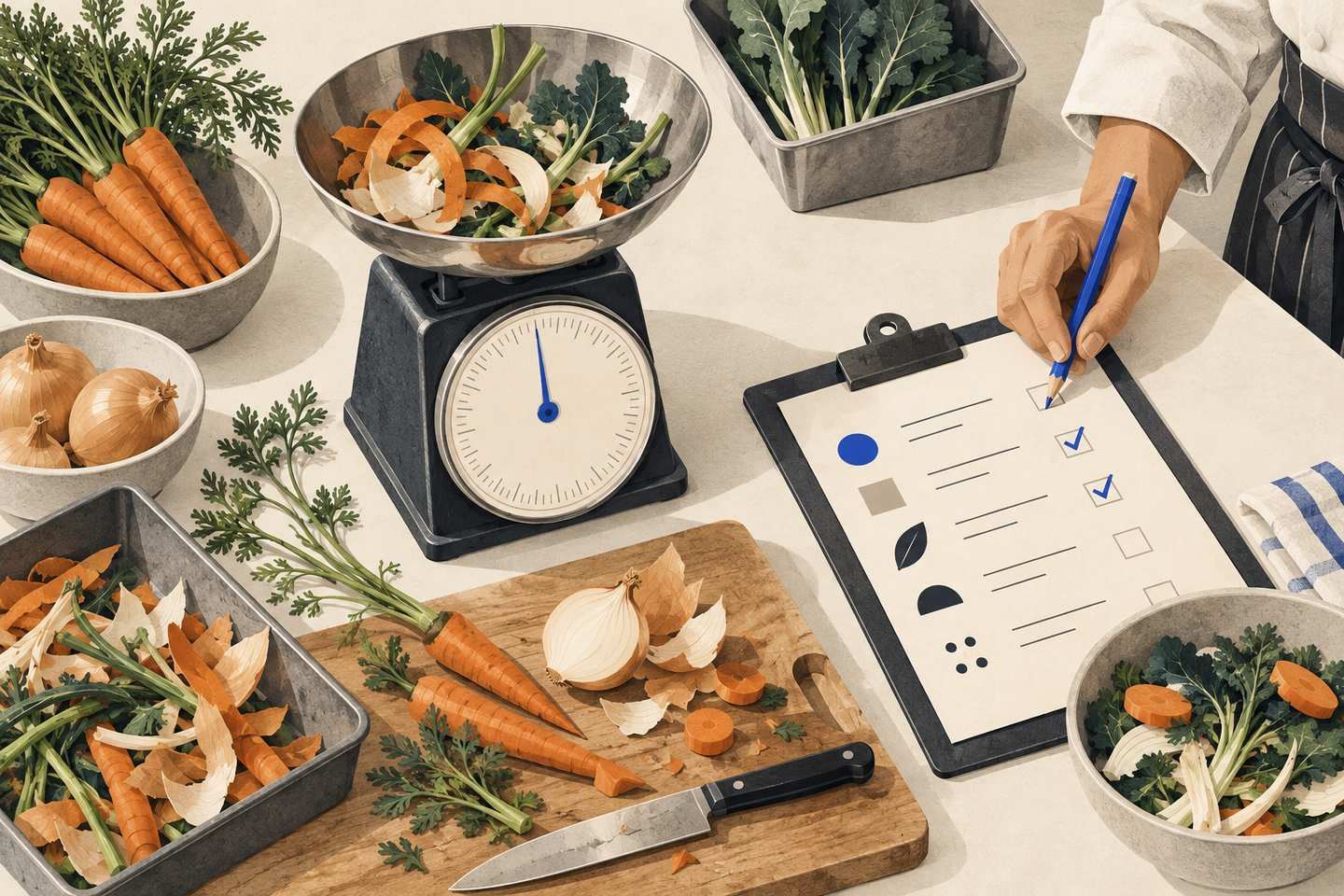
Cover: a reused original Nadali AI illustration of a kitchen worker beside scales, vegetables and trimmings. It is not a photograph of yield measurement or evidence of a test.