Author: Nadali. Prepared with AI assistance.
On November 5, 2026, CISA, the FBI, the U.S. Department of Health and Human Services (HHS), the Department of Agriculture (USDA) and the Department of Transportation (DoT) released a joint factsheet on securing industrial refrigeration and cold-chain monitoring systems. The date is confirmed by the official IC3 alert listing.
The agencies report malicious cyber activity targeting these systems globally. They specifically identify electronic temperature controllers and commercial refrigeration controllers in retail grocery and cold-storage facilities. The full factsheet provides practical measures for owners and operators.
Who benefits: shops and warehouses with networked refrigeration controllers. A restaurant using similar equipment also has reason to review remote access, but the factsheet does not describe individual restaurant attacks or attacks on Ukrainian businesses.
The risk described by the agencies
According to the factsheet, attackers may exploit vulnerabilities or weaknesses in unpatched or internet-accessible controllers to change settings and force continuous heating or defrost cycles. The listed routes include authentication bypass, arbitrary code injection and weak configurations.
Possible effects include inventory loss, reduced equipment service life, fire hazards and indirect harm to consumers if products are consumed after unsafe storage. A separate risk is losing visibility into current temperatures. These are possible consequences of successful interference, not a report of proven losses at a particular business. The factsheet names no affected companies, manufacturers, specific CVEs or loss amounts. Source: page 1.
What to check with your refrigeration and IT contractors
This is an editorial checklist based on the new factsheet and the 2025 baseline guidance for securing operational technology. The person responsible for the equipment should approve network and firmware changes: removing public internet exposure does not mean turning off refrigeration.
- Find the remote-access points. List controllers, control panels and service-provider accounts. Ask a specialist to check whether panels are directly accessible from the internet. Remove unnecessary access and protect necessary access with a firewall or other edge device running current software.
- Review accounts. Replace default passwords with strong, unique ones and limit who can change settings. Use phishing-resistant multifactor authentication where technically feasible. Allow only authorised devices and IP addresses to connect.
- Separate the equipment network. The factsheet recommends a dedicated virtual local area network (VLAN) for operational technology, separated from the business network. Have a specialist who understands refrigeration requirements implement it.
- Plan updates and recovery. Check firmware versions and manufacturer support. Schedule safe updates and replacement of unsupported devices. Keep current, tested backups offline and offsite; agree how to restore settings before changing them.
- Check temperature limits and alerts. Work with the service provider to define safe setpoint limits and alerts for deviations. As a practical check, establish who receives alerts overnight and who responds if communications or readings disappear.
- Keep event records. Enable available logs and assign someone to review unexpected changes. For equipment without usable logs, the factsheet recommends collecting network traffic and communications between devices; this is a technical specialist’s task.
If the readings are questionable
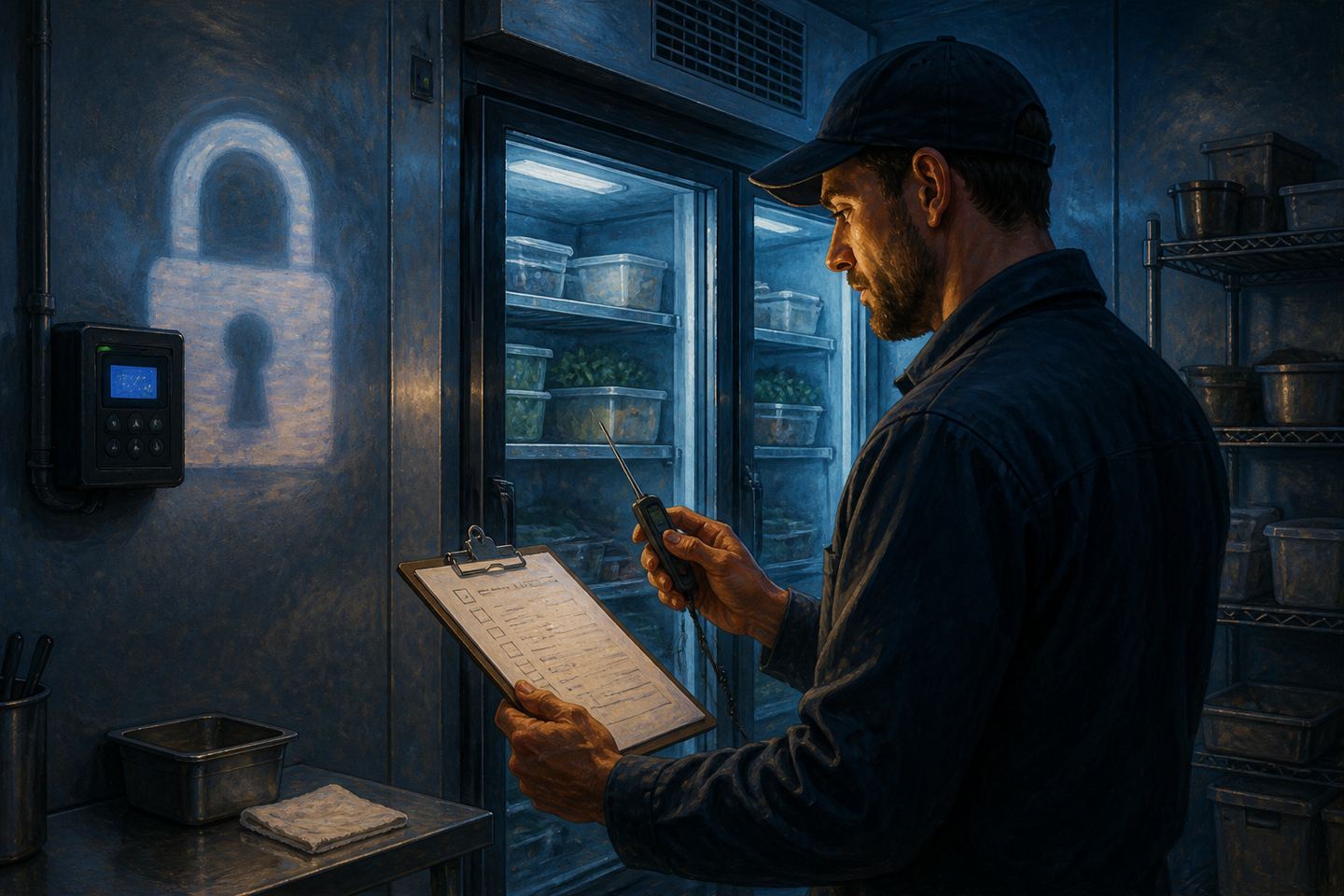
Our practical addition: plan to check temperature with a separate, functioning measuring device rather than relying solely on a panel whose access may have been compromised. Record the time, available readings and suspicious changes, and involve your service provider and food-safety lead.
Keep questionable stock out of sale or preparation pending assessment under your food-safety procedure. A normal temperature now does not, by itself, establish the storage history. Do not taste food to check whether it is safe, as FoodSafety.gov also stresses. Household guidance on how long food lasts during a power outage should not automatically be applied to interference that may have caused heating or hidden readings.
The first useful outcome is a clear equipment inventory, a secure access arrangement and a named person who responds to deviations. Nadali has not inspected equipment at individual businesses or established that a local attack occurred.
Sources checked on November 8, 2026.