In the GUIDE preprint submitted to arXiv on 12 October 2026, the authors report a specific failure: omitted numerical data in an ophthalmology test raised no alert because the checker only responded to discrepancies. The system assists experts preparing clinical guidelines. Preprint, full text.
How an omission can go unnoticed
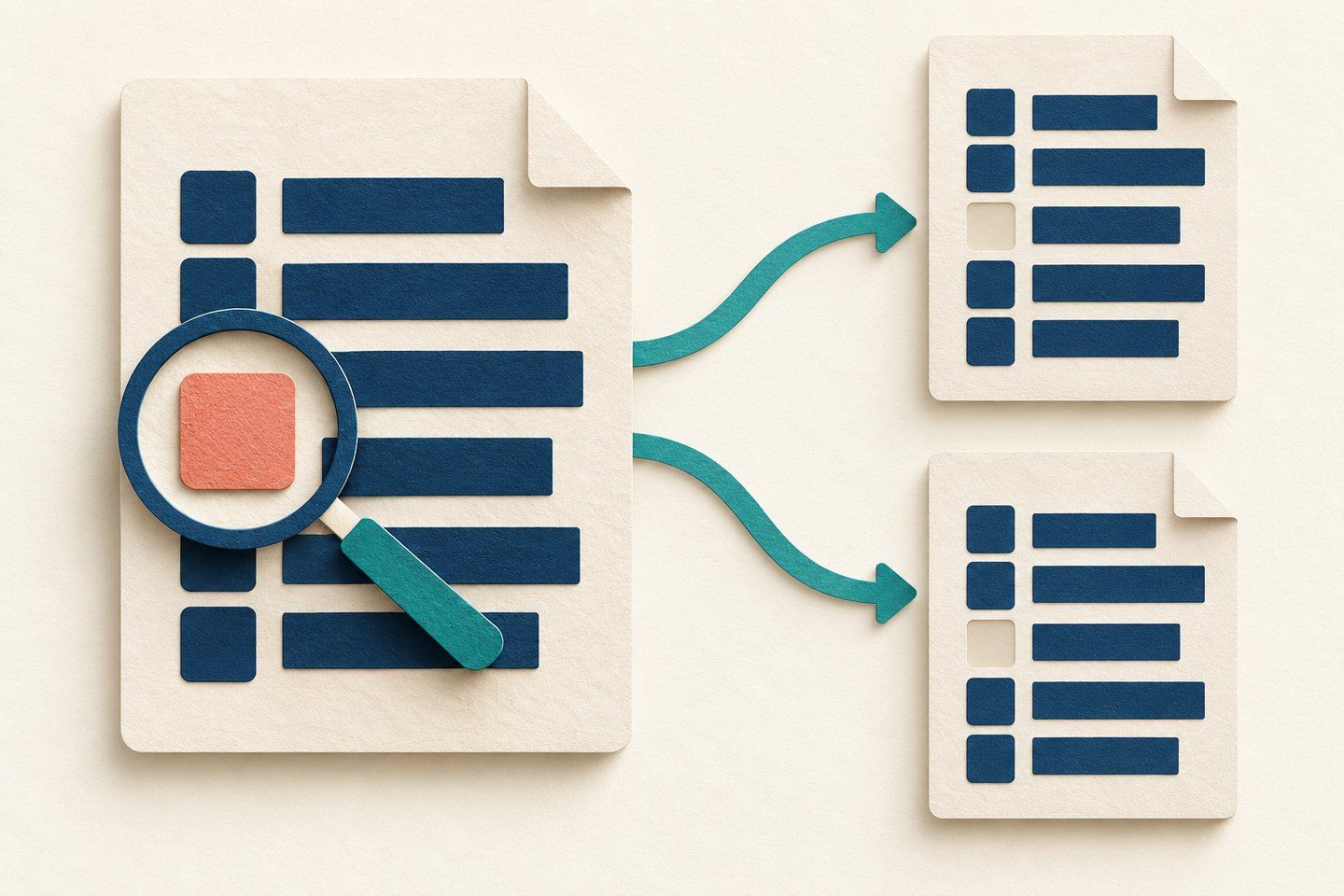
GUIDE uses two parallel data-extraction agents and a separate reviewer to compare their results. Our editorial inference from this design is that, if both outputs omit the same item, there may be no discrepancy to escalate. This explains a risk; it is not a published audit of every pair of errors.
An important qualification: the system flagged some omissions in a separate prospective case. That case concerned one cataract-related question. Two specialists worked with GUIDE, and 15 external specialists, blinded to the recommendations’ origins, rated the recommendations. Peer review of the preprint is unconfirmed, and the authors have not publicly released the source code. Methods and limitations.
What to check in a document workflow
For a clinic’s research or administrative team, or a small business preparing document summaries, it helps to separate two questions: “Do the answers agree?” and “Has all the required information been carried over from the source?”
Our practical suggestion is to define required fields before producing the summary. Then check each field’s value and location in the original, explicitly marking information as “absent from the source” when appropriate. An empty field should not automatically mean the document contains no relevant information.
The study did not separately test this procedure. It helps frame a completeness check, but establishes neither GUIDE’s suitability for clinical deployment nor patient benefit.
Prepared by the NADALI editorial team using AI
Sources checked on 14 October 2026. Preprint submitted on 12 October 2026.